Christopher Nolan has never been afraid to tell unusual stories with complicated plots. In Memento, he told the story backward, in Inception, he messed with our ideas of reality and time, and in The Prestige, he poked fun at the nature of identity and individualism. So when he wrote Interstellar, a time-jumping space epic about people trying to leave a dying Earth for a new home in the stars, it shouldn’t have been a surprise that it wasn’t simple.
Even if you mostly understand the movie’s first two hours of wormholes, gravitational propulsion theory, and the relativistic flow of time, it’s okay if you don’t understand the last hour. As the story builds up to its climax, not only does every major theme and theory of the movie come to a head, but it also throws a major curveball at the audience in the form of an infinite, interdimensional library that appears out of nowhere.
If you haven’t been able to figure out what happens at the end of the movie, don’t worry. We have answers. Below, we try to explain the strange and confusing ending of Interstellar.
In Interstellar, what was Dr. Mann attempting to achieve?
Earth is not a particularly pleasant place to live in Interstellar. Huge dust storms are destroying the world, harvests are failing, and the end of the human race is nigh. In its search for explanations, NASA has looked to the heavens.
At the start of the film, we discover that a team of 12 scientists has gone through a mysterious wormhole that opened around Saturn in order to determine whether or not the 12 planets on the other side are capable of supporting human life. A few years later, Cooper (Matthew McConaughey), Brand (Anne Hathaway), and the rest of the Endurance crew will go to the three most promising planets in the hopes of populating one of them. Dr. Mann (Matt Damon) welcomes them to his extremely cold location on the earth and assures them that it is ideal for human life.
The Orion Nebula, in our Milky Way Galaxy, is so bright that you can see it in the night sky! http://t.co/YIUv2wpFRg pic.twitter.com/sUnWxXAZUm
— Interstellar (@Interstellar) April 8, 2015
It turns out to be a trap, though. Though the initial crew of 12 scientists understood their journey would be one-way, Mann says he never gave any thought to the potential that his home planet might be inhospitable and he would perish there. He resisted for a long time, but in the end, he decided to fabricate his survey data and lure another crew to his planet so that he could use the Endurance to get away. Mann is now willing to do everything to get away, including murder. When Mann realizes what he’s done, he becomes afraid that the Endurance crew won’t help him get away, so he tries to kill Cooper to cover his tracks. That’s right, this is a murderous Matt Damon—the likes of which we seldom see in films.
How may a man’s plan go astray?
Mann sabotaged and set traps on his robot that was storing the fake survey data so that no one would find out until after he escaped that he had made up the data. Mann’s meddling causes a huge explosion, but the Endurance robot TARS is able to get away. Even better, TARS shows that he has turned off the shuttles’ automatic docking system. This means that even though Mann has Cooper’s shuttle, he can’t dock with the Endurance.
Cooper, on the other hand, stayed alive long enough after Mann tried to kill him to call for help, and Brand picked him up in the second Endurance shuttle. Even though Brand and Cooper tell Mann that trying to manually dock with the Endurance won’t work, the scientist tries anyway, determined to leave his planet by any means necessary. But when he tries to open the airlock of the shuttle so he can get into the Endurance, the airlock blows up, killing Mann and sending the Endurance into a fast spin.
Cooper is finally able to dock with Endurance and stop the spin with the help of TARS and the other robot on Endurance, CASE. But by then, the ship is badly damaged and doesn’t have enough fuel to go anywhere safe. This means that Cooper and Brand are stuck in space. What a terrible day at work!
How does Cooper plan to reach Edmund planet?
Cooper wants to use the gravity of the black hole Gargantua to do a slingshot maneuver that would send the Endurance in the direction of the third potentially habitable planet, where a scientist named Edmunds lives. This would give the Endurance enough momentum to reach Edmunds’ planet. But, as was shown earlier in the movie, every time the Endurance crew gets close to the black hole, the black hole’s gravitational field warps their sense of time because of relativity. What they think is only a few minutes pass as years for everyone outside of Gargantua’s gravity.
By using Cooper’s slingshot move, he and Brand will “slip” through 51 years of time. They both realize that this means Cooper will have to give up hope of ever seeing his children again on Earth since they will probably have died of old age by the time the Endurance leaves Gargantua’s gravity. Still, Cooper is aware that his plan is the only way for people to survive.
Mann’s earlier speech about the last moment a person has before dying makes Cooper’s choice even more dramatic. Mann says that as our brains try to keep us alive, we will see a vision of the thing we most want to see again. Mann thinks that Cooper’s last image will be of his children, who give him a reason to live. Cooper puts the future of humanity ahead of his own desire to live by giving up hope of seeing his children again.
Where does Cooper go after the film’s conclusion?
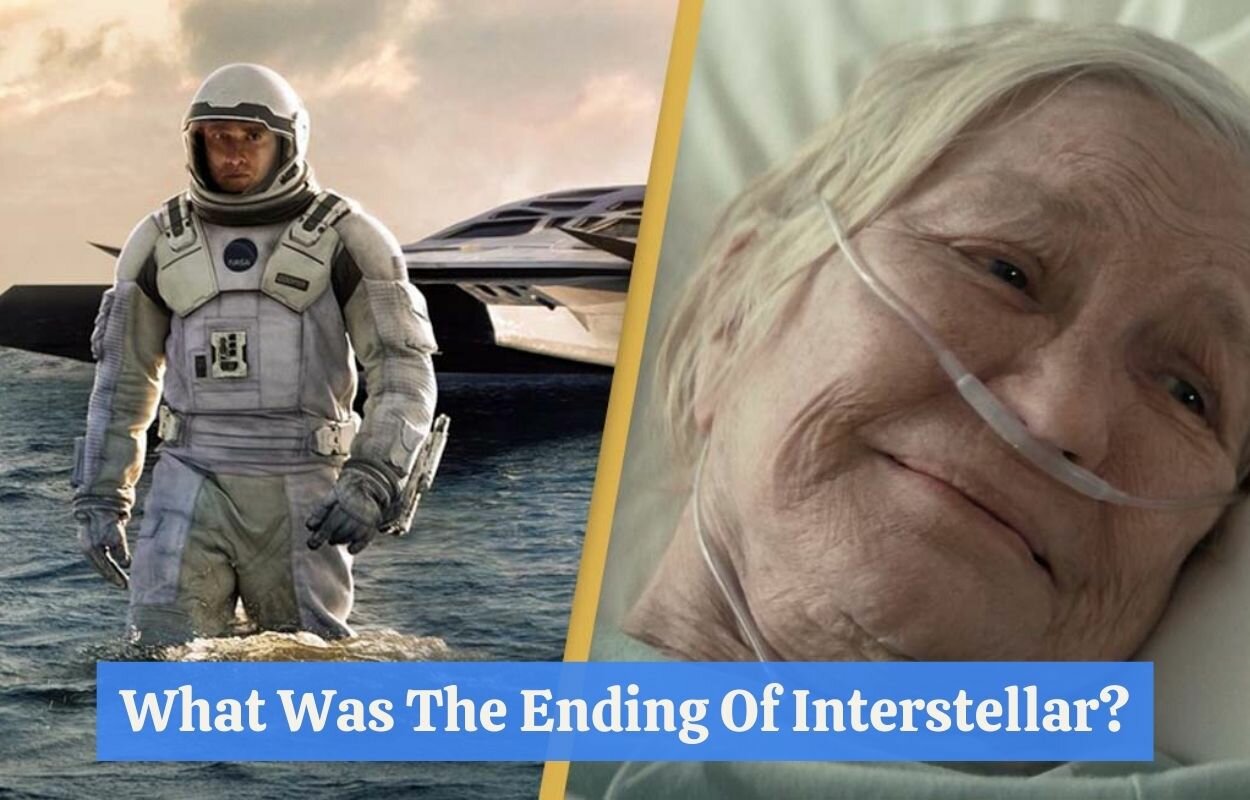
Due to “time slippage,” which Brand warned about before doing the slingshot maneuver around Gargantua, at least 51 years have passed for the people of Earth (and possibly even more, since Cooper spent more time in the black hole than he factored into the slingshot calculation). But Cooper has only been there for a few hours. When he finally gets to Cooper Station, his daughter Murph, whom he last saw when she was a little girl, is an old woman about to die. On the other hand, it looks like Cooper is about the same age as when he left.

Cooper is very happy to see his daughter again, but Murph tells him that she won’t live much longer and that he should leave so he doesn’t have to see her die. Cooper listens to his daughter’s advice and steals a ship. He plans to go back through the wormhole and meet Brand on Edmunds’ planet. She would have just arrived like Cooper, and she will soon go into hypersleep, which will keep her the same age until he reaches her.
During the decades Edmunds spent waiting for NASA to send a team to his planet, he sadly passed away. But when Brand takes off her helmet and breathes in the air of her new home at his grave, it’s clear that this is the planet the astronauts have been looking for, where humanity can rebuild and, eventually, thrive again.
In Interstellar, what was the equation that Murph was attempting to solve?
In Interstellar, there is a lot of talk about the gravitational equation that Professor Brand and then Murph try to solve for decades. Brand tells Cooper early on that for “Plan A,” in which people move to a new planet in a different solar system, to work, he needs to figure out the equation while the Endurance is out looking for possible new homes. Later, when Brand is on his deathbed, he tells Murph that he has always known that the equation can’t be solved without the quantum data from inside the black hole and that Plan A has always been a lie.
Black Hole Photo Shows Christopher Nolan’s #Interstellar Wasn’t So Far Off From the Real Thing https://t.co/XSxMKCj6Jb pic.twitter.com/4zjoi3j0tA
— IndieWire (@IndieWire) April 10, 2019
As for what the equation is supposed to do, it all has to do with the movie’s main theme, which is gravity. For Plan A to work, Brand needs to figure out how to get all of humanity into huge space stations and away from Earth. People have the technology to send individual shuttles into space, but sending city-sized space stations into space is a different story. To do this, people need to learn how to control gravity. Without figuring out the gravitational equation, people are too big to leave Earth and will die slowly on a planet that is dying.
Murph does figure out how to solve the equation after Brand dies, though. This is because her “ghost” father gives her information through the tesseract that helps her do so. Interestingly, because the tesseract lets Coop talk to people in the past and future, the information Murph needed to solve the equation has been in the watch her father gave her for years. She just didn’t know it.
Isn’t the ending of Interstellar a paradox?
When Cooper finds out at the end of Interstellar that “They” are actually the people of the future who made the tesseract and the wormhole to help the people of the past survive, it raises some very important questions. How can the people of the future save the people of the past if the people of the future can’t even exist without the people of the past? This is the most obvious question.
A “bootstrap paradox” is a theory in which the cause of an event turns out to be the result of the same event. Even though it seems impossible, there might be a way to explain it in the world of Interstellar. One possibility is that humanity did die out on Earth in the “original” timeline, but Brand’s “Plan B” colony on Edmunds’ planet lived, grew, and eventually learned how to go back in time and change the past, making a new timeline.
But there may be a simpler explanation that doesn’t involve multiple timelines: time in Interstellar just doesn’t move in a straight line. Several characters spend a lot of time in the movie trying to explain that the way we think about time may not be very accurate and that people in the future may have a very different view of time than we do. This could mean that our ideas of cause and effect are wrong and that we are wrong to think that cause must come before the effect. Maybe in Interstellar’s world, time isn’t a line at all, and our strong belief that cause and effect can only move in one direction just shows how little we know.